THE DISCOVERY OF THE AMAZON RIVER

The first European to navigate the Amazon River was Francisco de Orellana, a Spaniard from Extremadura. He was an enlightened man who, in addition to Castilian, spoke French and Latin. He named this impressive river in 1542, as his soldiers reported being attacked by many native communities, but above all, they remembered with amazement some fierce, semi-naked warrior women who shot poisoned arrows at them, similar to those in Greek mythology and identical to the legendary Amazons.

In addition to Captain Francisco de Orellana, Francisco Pizarro's brother, Gonzalo Pizarro, also participated in this expedition. Gonzalo organized and led the expedition along with 57 other soldiers. After several days in the dense Amazon rainforest, they decided to split up. One group built a brigantine called the San Pedro and set sail with their men in search of supplies and help, but the Amazon River's current carried them downstream to the river's mouth. Their objective was to explore the unknown Amazon jungle and find the fabled Land of El Dorado and Cinnamon, but they ended up discovering the great Amazon River and opening a new waterway to the Atlantic Ocean.

The Dominican friar Gaspar de Carbajal, a native of Trujillo, also participated in the expedition, as did Orellana, who wrote the chronicle of this incredible adventure. In one of his notes, he describes that "for several days they went hungry until one Easter Sunday they met some very kind natives who gave them yucca, turtles, plantains, etc., so that night they were able to have a great Easter feast on Quasimodo Sunday."
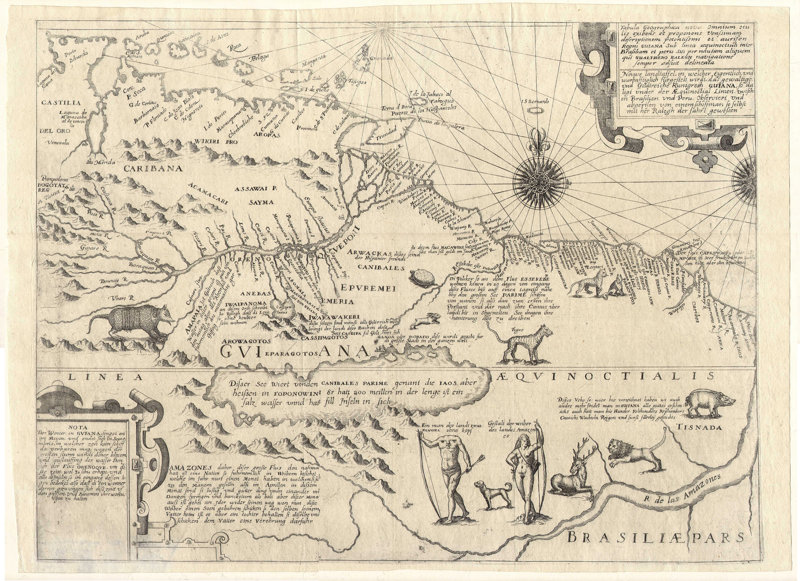
After waiting for Gonzalo Pizarro for a while and seeing that he hadn't shown any signs of life, they decided to say goodbye to these friendly natives and depart on April 24th to continue their journey. Orellana's odyssey covered thousands of leagues of remote places, incredible landscapes, strange animals, and so many other things, all new to the crew. In some places, the Indians were generous, giving them turtle eggs and unknown fruits, while in others, they harassed them with canoes from which they launched arrows and darts. These natives wore clothing made from the hides of caimans and tapirs. The expedition members recounted that once they went ashore to hunt turtles and managed to gather almost 2,000, but they had to leave half behind because some Indians attacked them furiously, shouting, playing wooden trumpets, and throwing poisoned darts.

On May 5th, one of the Spaniards shot a bird with his crossbow, but the crossbow bolt and the bird fell into the water. Luckily, a fish swallowed it, and they were later able to capture it. According to accounts, that fish was over five palms long. As time went on, the expedition members realized they were on the right track, as the deeper they ventured into the jungle, the rivers became larger and more powerful, and some tribes became increasingly warlike, some with thousands of warriors. Once they reached a village on the riverbank, the locals were so hostile that they refused to let them disembark and obtain food and water. So, they had no choice but to continue their journey, growing ever hungrier but with the hope of reaching their destination.

On Ascension Day, the Spaniards reached a confluence of three rivers that, according to them, resembled the "four rivers of paradise." They then reached a river with three islands where, to their astonishment, the Indians used glazed pottery similar to that of Malaga. The people had large ears like the Indians of Cusco, who passed by in their canoes very close to the Spanish vessel without flinching, paddling with their oars without letting themselves be swept away by the strong current of the river.

Further downriver, some natives told him that there was a king who had much gold and silver and owned sheep (llamas and alpacas) like the kings of Peru. This made it clear that the Indians of the Peruvian highlands had territories and properties in these remote places of the Amazonian territory. A few leagues from present-day Leticia, they found an ink-colored river which they named Rio Negro, a name that endures to this day. For 20 leagues they navigated this strange river of dark waters that did not dilute.

After waiting for Gonzalo Pizarro for a while and seeing that he hadn't shown any signs of life, they decided to say goodbye to these friendly natives and depart on April 24th to continue their journey. Orellana's odyssey covered thousands of leagues of remote places, incredible landscapes, strange animals, and so many other things, all new to the crew. In some places, the Indians were generous, giving them turtle eggs and unknown fruits, while in others, they harassed them with canoes from which they launched arrows and darts. These natives wore clothing made from the hides of caimans and tapirs. The expedition members recounted that once they went ashore to hunt turtles and managed to gather almost 2,000, but they had to leave half behind because some Indians attacked them furiously, shouting, playing wooden trumpets, and throwing poisoned darts.

Three years later Orellana would return to NEW ANDALUSIA, the territory between the Orinoco and Amazon rivers that he had discovered. This time he sailed first along its mouth and ventured deep into the Amazon jungle, where he would die in November 1546 in some unknown place without a cross or a tomb, but his legacy has remained among the great discoveries of humanity alongside the great explorers and travelers of history.

Armando el cronista


Comentarios
Publicar un comentario